

How Do American Vietnam Veternans Feel About Service Experience
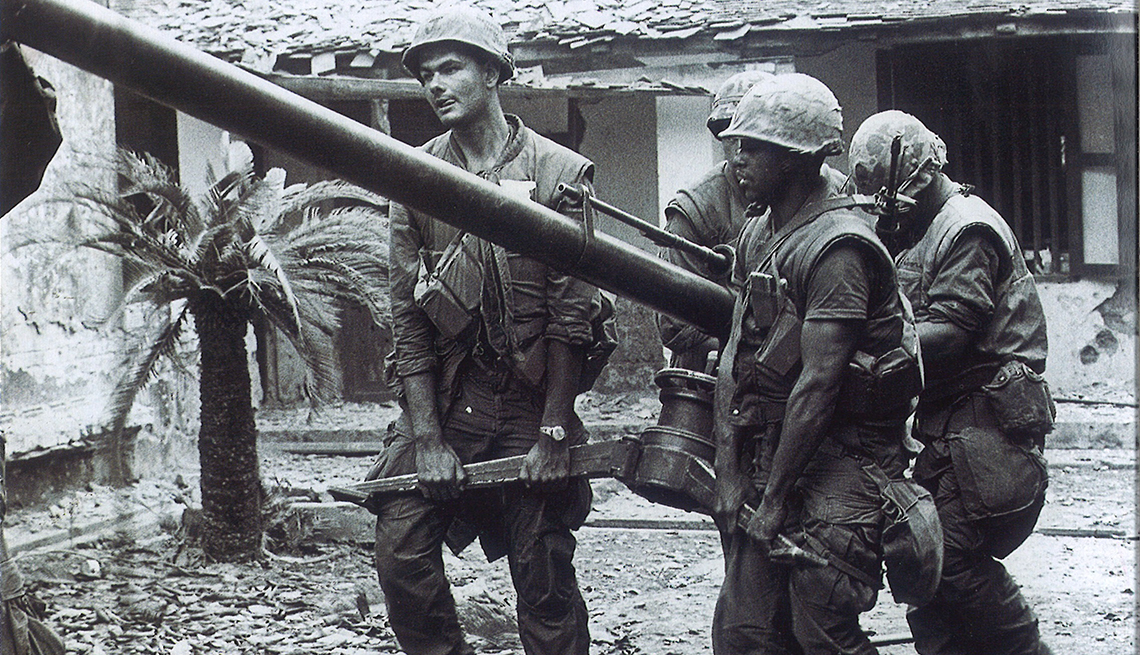
Photo courtesy of Bob Wallace
Bob Wallace (far left) helps carry a 400-pound 106mm recoilless burglarize through the streets of Huê´, Vietnam, during the Tet Offensive in 1968.
The Vietnam War helped shape a generation of Americans, none more and then than the two.vii million who served in Southeast Asia. In award of National Vietnam War Veterans Twenty-four hours on March 29 (signed into law by then President Donald J. Trump in 2017), AARP spoke with 6 veterans of the war almost their most vivid memories and what they desire Americans today to know or remember.
Len Kirchner, M.D., 85, of Litchfield Park, Ariz.
Kirchner entered the Air Force in 1961, at age 25. He served in Southeast Asia equally a doctor and in combat missions from 1965 to 1971.
Photos Courtesy of Len Kirchner
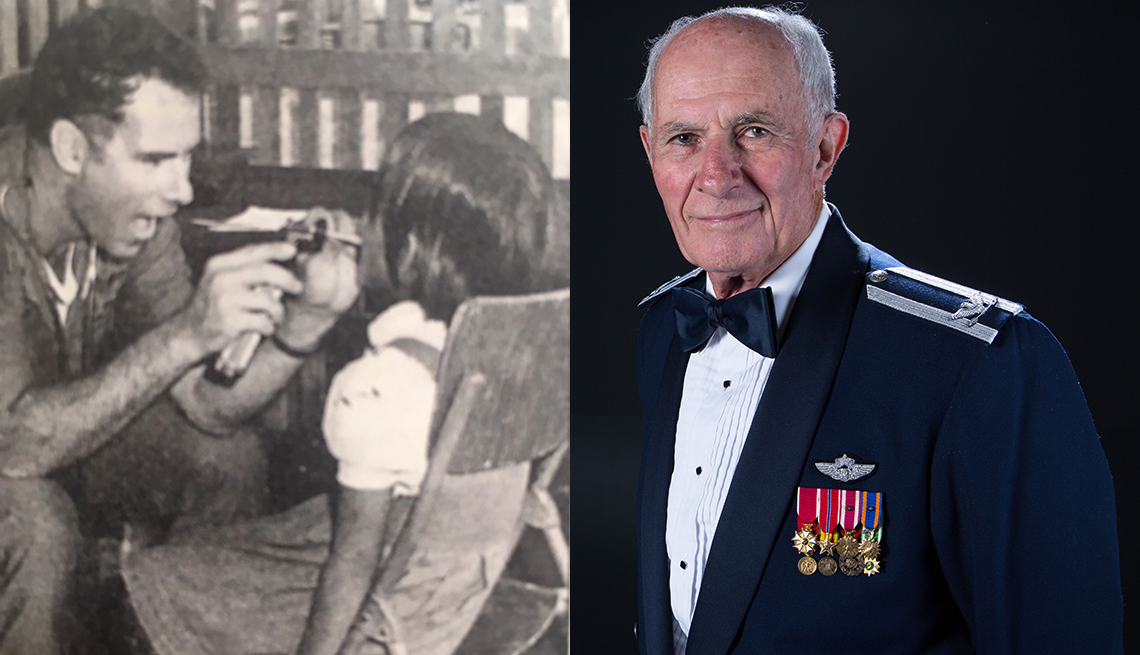
Len Kirchner examines a Thai boy during civic activeness (left); Kirchner in his apparel uniform.
Most vivid memory: his starting time time landing in Vietnam, after existence stationed in Tokyo
"We had flown a ten-hour reconnaissance mission from Okinawa, forth the coast of China, then into the Gulf of Tonkin, and did reconnaissance between Haiphong and Hainan Island, which was Chinese. When nosotros landed at 2 in the morn, we got out of that airplane — and empathise, this is my first trip to Vietnam. It'due south hot and it's sticky. The Marines are on Monkey Mountain, arms is firing out into the jungle, there are flare ships dropping flares. I got a sidearm and bandolier armament. And to be frank, when I think back, I recall, How did I get into this John Wayne movie, anyway?"
What Americans should know: Wandering into war doesn't always end well.
"I think the most important thing is that going to state of war is such an important decision made past our political leaders. And when you lot think back during my lifetime, Globe War II, conspicuously the Japanese attack on Honolulu precipitated that. The second nation conflict was Korea, and Harry Truman made a conclusion to stop the aggression from the North into the South. Vietnam, that was something that we simply kind of wandered into over a menstruation of years. So going to war, I think, is i of those critical things that a president and Congress does. And we haven't done a decent job, since World State of war II and Korea, in debating and articulating what the mission was and what our goal was and what our strategy was."
Keith Harman, 74, of Delphos, Ohio
Harman was drafted in 1967 and served in Vietnam in 1969, as a coiffure master and door gunner on a "Huey" helicopter for the Army. He was the Veterans of Strange Wars national commander from 2017 to 2018.
Photos Courtesy of Keith Harman
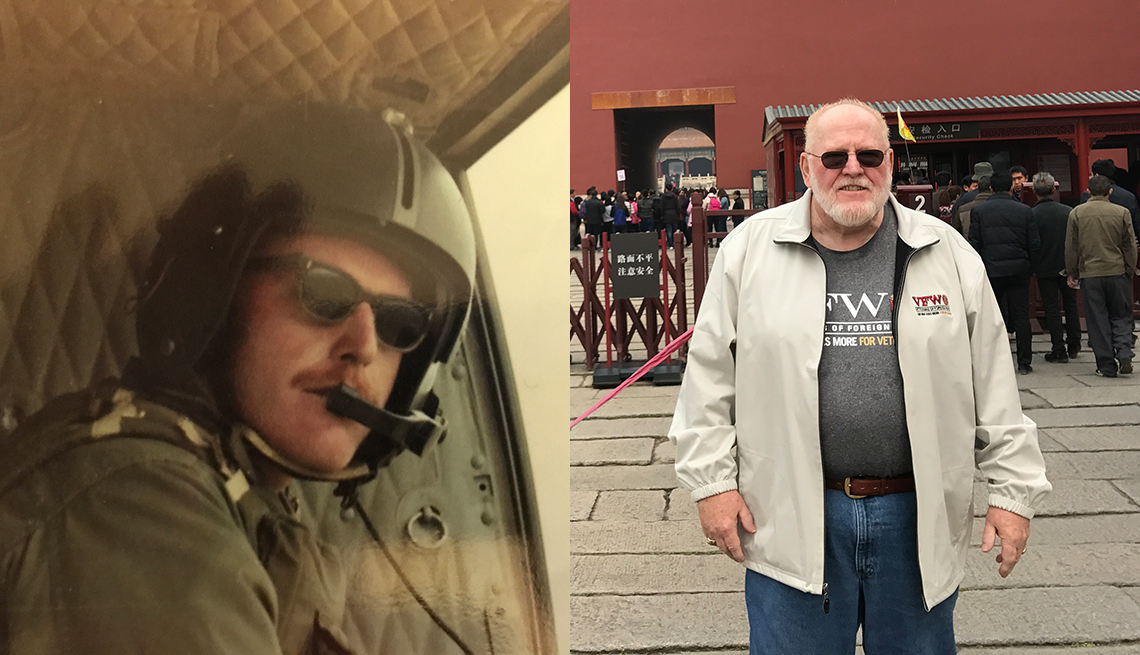
Keith Harman in a Huey Helicopter during the Vietnam War (left); Harman on his return visit to Vietnam in 2017.
Most vivid retentivity: being defenseless nether fire in his helicopter on his first mission
"I recollect my maintenance sergeant trying to talk me out of becoming a crew chief, simply I wasn't listening. On my get-go assault mission, my shipping was desperately shot upwards, merely we didn't go down. The first thought that came to mind was, Maybe I should have listened to my maintenance sergeant. I had a skillful guardian angel and continued to fly for the remainder of my tour."
What Americans should know: Servicemen did what was asked and looked after one another.
"When you serve in the military, you are taught discipline. The visitor that I served with was told that we were going to Vietnam, so off we went. We did what was asked of the states, and we looked after those that we served with. I accept been back to Vietnam, and it is altogether dissimilar from when I left 49 years ago."
Mike Tharp, 75, of Plano, Texas
Tharp served in the Army from 1969 to 1970 and was a correspondent for an Ground forces mag called the Hurricane.
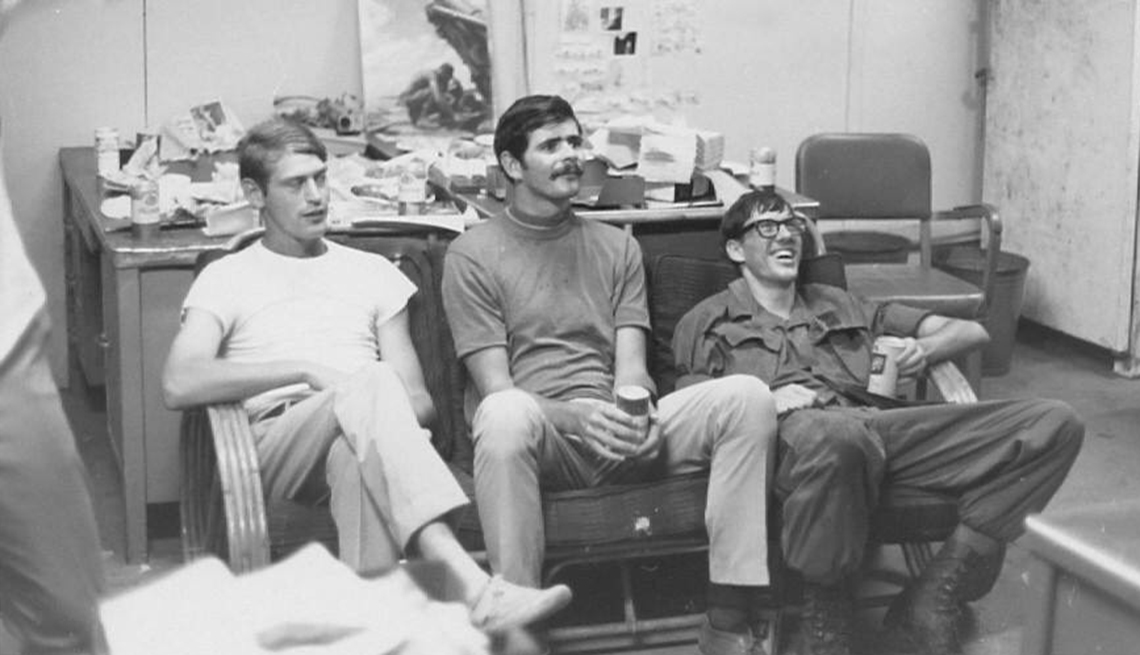
Photo Courtesy of Mike Tharp
Mike Tharp (center) at the 16th Public Information Disengagement.
Most vivid memory: being shot at for the first time
"I was on guard in a wooden belfry on the front perimeter which faced Highway 1, which ran into Saigon about 30 miles south. There was fire coming from the Vietnamese village across Highway one. I was in the bunker, the elevated bunker, and every 8th or ninth round was a tracer round — ruddy or greenish. So you know when you saw tracers, at that place were a lot of bullets you didn't see. The tracers started coming over the guard shack where I was continuing, xx feet above the ground or and then. And I aptitude down below the sandbags with just my head and my helmet peering over, and I peed my pants."
What Americans should know: Too many lives, both American and Vietnamese, were lost.
"Nosotros should accept never gone into that war. We went in there in Vietnam and wasted 58,000 American lives and hundreds of thousands of Vietnamese. And when I speak of Amanuensis Orange, about 4 one thousand thousand Vietnamese were exposed to Agent Orange, and several hundred thousand of them died, and many of their children and grandchildren are messed up because of it. I think the lesser-line lesson is that we should non go to war unless information technology is clearly in our national involvement, and at that place are very few places that would qualify for that in the earth."
John Rivers, 75, of Paradise Valley, Ariz.
Rivers served from 1969 to 1971, as an Army infantry officer advising a Vietnamese armed forces infantry unit.
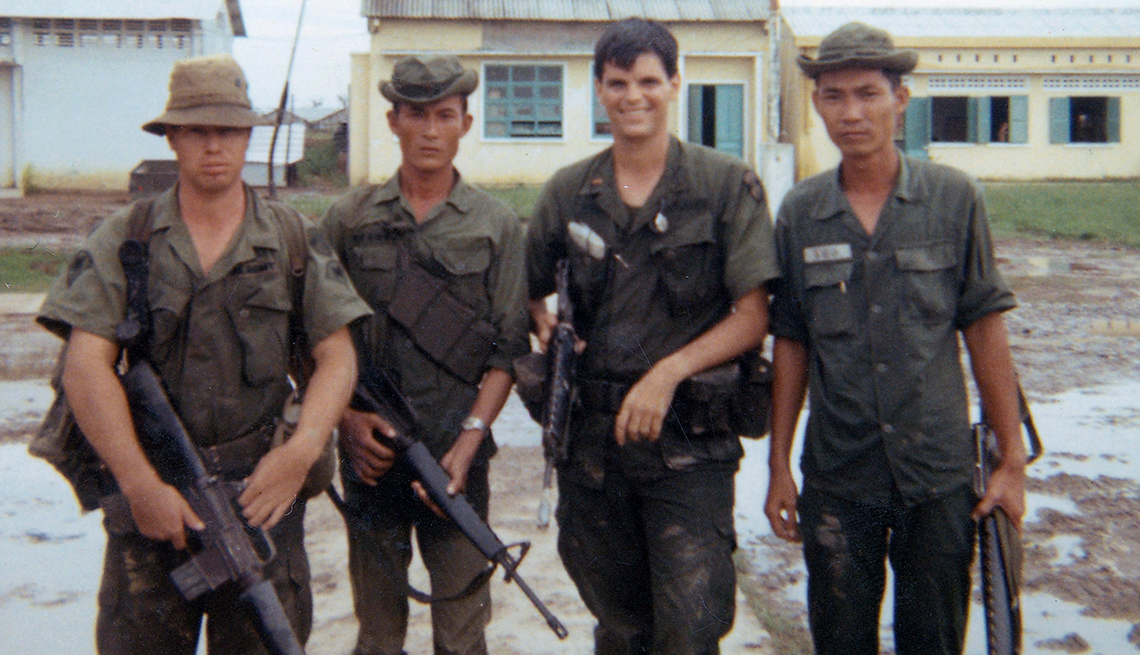
Photo Courtesy of John Rivers
John Rivers (second from right) after his final gainsay performance.
Nigh vivid retention: personal relationships with Vietnamese soldiers and families
"We pretty much lived and worked with the Vietnamese. And that gave united states of america, in most cases, a significantly unlike view of the war than people who were in your typical American units, who simply viewed the Vietnamese as 'the other guys,' and so to speak. I developed great respect and affection for the Vietnamese when I was in that location. Primarily because I had so much exposure to them and their families."
What Americans should know: Vietnam veterans served with every bit much sacrifice as any in American history.
"The men and women who served in Vietnam were every bit important to our country as veterans who take ever served since the time of the American Revolution. Those who did not come back alive made equally great a sacrifice as any solider who died at Iwo Jima or Omaha Beach or any of the other major battles of World State of war II. The grief and the sorrow of their families was as profound as the grief of whatever family unit who lost a family member at Guadalcanal or the Battle of the Bulge or any of the other battlefields of our wars. For those of united states who served, our experiences equally soldiers was very like in many respects to the soldiers who fought in other wars."
Bob Wallace, 72, of Arlington, Va.
Wallace served in the Marine Corps equally an infantryman. He was the executive director of the Veterans of Strange Wars function in Washington, D.C., until July 2019.
Most vivid memory: fighting in the Battle of Huê´ during the 1968 Tet Offensive
"Many casualties on both sides, merely exceptional camaraderie de corps by my fellow Marines."
What Americans should know: Most who served volunteered for duty.
"Americans should know that those of united states who fought in Vietnam answered our nation's telephone call, and most of u.s. were volunteers. Nosotros served with honour and distinction."
Jim Doyle, 72, of Fresno, Calif.
Doyle served from 1969 to 1970, as an Ground forces infantry soldier, to "seek out, close with and destroy the enemy."
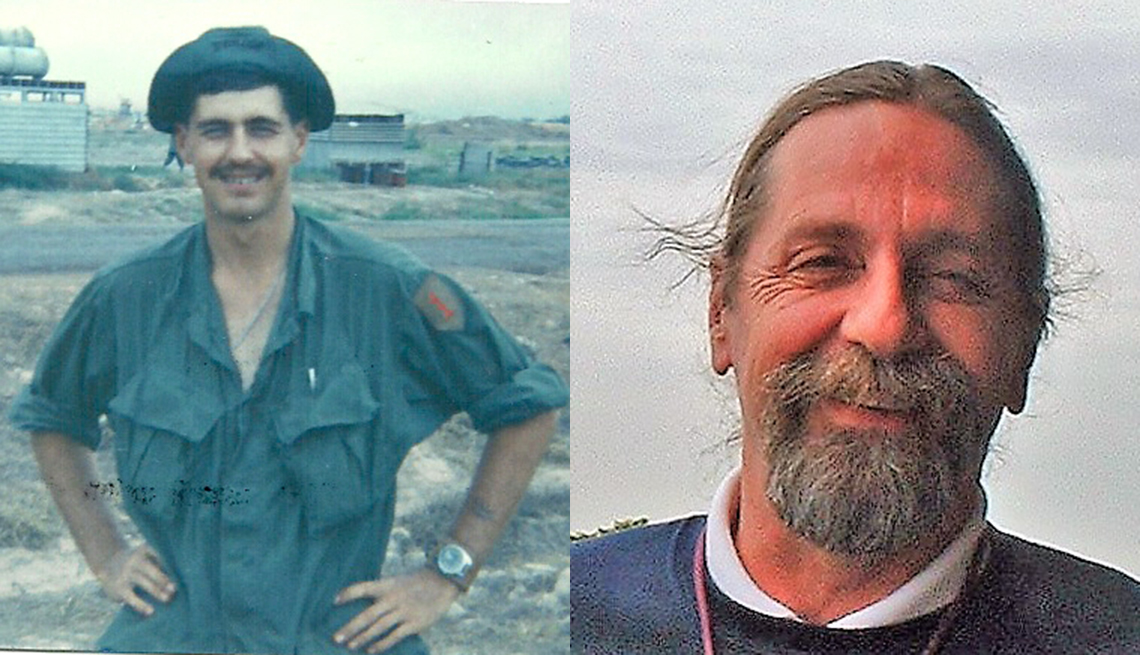
Photos Courtesy of Jim Doyle
Jim Doyle in Di An, South Vietnam, 1st Infantry Division base camp, 1969 (left); Doyle today.
Most vivid retention: being wounded in a blast on patrol, along with a wartime buddy, Willie Henry, and non knowing what happened to his friend until 26 years later
"After two to three weeks of recovery, I was dorsum out in the field and never did notice out what happened to Willie. For years and years I didn't know how to get ahold of him. I didn't know annihilation. And so when the [Vietnam] memorial was built, I looked for his name, didn't discover his name, which was a adept clue that he was still alive. And for some reason, I thought he was from Chicago. So every time I traveled through O'Hare, I would grab the phone volume, back in the days when they yet had phone books and pay phones, and I chosen every Henry in the Chicago phone volume and relay the story: 'So, exercise you know this guy, I'one thousand trying to find him.' 'No, never heard of him.'
"So in '96, a friend of mine was appointed to a job at the Department of Veterans Affairs equally a deputy or assistant secretary for something or other. And I relayed the story to him, and he says, 'Well, await, I tin't give you whatsoever information. But if you send me a letter addressed to Willie, I volition forward it to him. And if he wants to contact you, he tin exercise that.' So I did that, and well-nigh a month later, I was in D.C. I was on the board of Vietnam Veterans of America at that time. And I was in my hotel room, and the phone rang, and information technology was my married woman.
"She says, 'You got a message on your machine that I call up you're gonna want to hear.' So she held the phone over the motorcar, and it was Willie, who called and said, 'I got your letter.' I called him and left a bulletin on his auto. About an hour subsequently, he called me dorsum at the hotel, and that was when we connected, 26 years later." [Willie, it turns out, was in Chattanooga, Tennessee.]
What Americans should know: The men who fought didn't create the war.
"All the people who fought the war weren't responsible for making the war. If there is annihilation we've learned from the Vietnam State of war, it is that we haven't learned anything from the Vietnam State of war."
Aaron Kassraie writes about problems important to military machine veterans and their families for AARP. He also serves as a general assignment reporter. Kassraie previously covered U.S. foreign policy equally a correspondent for the State of kuwait News Agency'south Washington bureau and worked in news gathering for USA Today and Al Jazeera English.
Editor's note: This commodity, originally published on March 28, 2019, has been updated with new data on the veterans featured.

How Do American Vietnam Veternans Feel About Service Experience,
Source: https://www.aarp.org/home-family/voices/veterans/info-2019/vietnam-veterans-day.html
Posted by: kingwern1962.blogspot.com
0 Response to "How Do American Vietnam Veternans Feel About Service Experience"
Post a Comment