

What Are The Four Different Models Ofethical Decision Making For Human Services
iii Ethical Determination Making
The purpose of this chapter is to:
- one) Outline the decision making procedure
- ii) Explain the nature of upstanding decision making
- iii) Provide ethical frameworks used in making decision making
Decision Making
This chapter introduces us to the concept of upstanding decision making. To properly contextualize our understanding of upstanding determination making, maybe it would be prudent to dissever the ii elements – decision making in general, and and then ideals. Managers brand thousands of decisions every day. In near cases they intuit the decision making process and can come to the best solution within nanoseconds of hearing about a problem. These are the types of bug that are routine, and take low consequences. However, the large decisions that managers take to regularly make require more due diligence, forethought, and collaborative effort with colleagues. These bug portend serious consequences, and in many cases organization functioning depends on good decision making. Hannaway (1989) found that managers are in a constant state of making decisions as "[they] switch often from job to chore, changing their focus of attention to answer to issues as they arise, and engaging in a large volume of tasks of short duration" (p. 39).
Conclusion making is the activity or process of thinking through possible options and selecting one (Vivid et. al, 2019). A rudimentary framework for how managers engage in the decision making process contains iv steps.
- 1) Place the problem
- 2) Generate alternatives
- 3) Decide on a class of activeness
- iv) Implement
At that place are several means that a manager tin can utilize this framework to make decisions – intuition, assay, democratic process, etc. Withal, they all contain the aforementioned elements of problem identification and and so evaluating alternatives earlier deciding on a grade of activity. The intuitive decision maker simply "knows" what the problem and alternatives are before acting. A managing director using analytical tools might uncover new insights from trying to really figure out what the problem is. A democratic manager will rely on the utilise of the squad to work through understanding the trouble and figuring out alternative courses of activeness.

Identify the Problem
The showtime challenge in determination making is working to empathise what the trouble is. Ineffective managers focus on the symptoms without identifying the underlying issues. A child with a runny nose does not have a runny nose problem, she has an communicable diseases causing a running olfactory organ. The implication here is simple; if we treat symptoms, the problem will copy the symptoms if given plenty time. For the child, let's say we stuff endless Kleenex up her nose. This won't accost the virus creating this symptom and others (temperature, cough, etc.) In a like way, a firm might take a turnover issue and put resource towards paying people more, improving conditions, or added benefits. However, without truly agreement the crusade of the turnover, these resource are wasted. The turnover in this scenario is being caused by an unbearable manager that makes life miserable for employees. No amount of pay enhance or piece of work status changes will keep someone around for very long when abuse like this is happening.
A college freshman turns his paper in to the professor during the first calendar week of class. A week later the professor calls the student into her part and states simply "You got a D on the paper, merely I have good news. You don't have a writing problem." The educatee is confounded, and asks the professor to explain. "Yous don't in fact accept a writing problem, you have a reading problem. Yous write like you speak, which tells me that you do not read very much. I recommend that you read more. Annihilation you want, just read – Men'southward Health, your textbook, Dostoevsky, and this will make y'all a meliorate writer. You will naturally imitate what you are seeing." A skillful director tries to understand what is causing the symptoms. Outset step is to identify the real problem.
Generate Alternatives
Problems come in dissimilar scopes and magnitude. In some cases they are routine, like a managing director putting together a shift schedule for the week. The trouble identification is simply a thing of understanding that personal preferences and personal obligations volition conflict as he tries to schedule shifts. This trouble does not crave the manager to generate a wide list of alternatives. It might include negotiation, allowing workers to swap shifts, or but making a schedule and forcing employees to deal with information technology. However, there are bigger bug that require a manager to generate a long and comprehensive listing of alternatives. When problems have intense consequences, or the context is an unknown 1 to the system, a wide list of alternatives is necessary. The hereafter is unknown, and the trouble is dissimilar ane you've ever seen. This is the time to brainstorm, get creative, and generate alternatives.
Consider a company dealing with the aftermath of a mass shooting incident. Consider a fast nutrient restaurant trying to remain solvent during a national pandemic that requires consumers to remain at home. Consider a company in New Mexico who screens job applicants for drug use, and they are taking job applicants from Colorado where marijuana utilise is legal. Consider an plane manufacturer who lost consecutive contract bids and has to cut expenses somewhere. Each of these problems are serious that require managers to generate a wide list of alternatives.
If nosotros encounter a trouble we have seen before, nosotros don't demand to stray likewise far to find viable alternatives. However, when we face a new trouble in an unknown context, we need a wide range of alternatives. Here's a elementary illustration. Consider the following three questions:
Provide a range of outcomes (low and loftier estimates) for the following questions:
How many US Presidents have resided in the White House?
What is the population of Reykjavik?
How many Sasquatches per square mile reside in the Pacific Northwest?
If yous have any frame of references for these questions, your range of outcomes volition probably be narrow. If y'all have no thought, you need to respond the question with a wide range. Almost of us have a general idea that the number of total US Presidents is somewhere in the forties, and mayhap nosotros can recall from a loftier school American History class that the British burned the White House during the War of 1812, which was probably four to 5 presidencies in, and the White Business firm has existed at least since then. This means we tin approximate that the range is 35-45 presidents have lived at that place (The first was John Adams, making the correct answer 44). Reykjavik is in Iceland, and if you knew that you likewise know it has a small population, and the city probably does not crack the world's top 100 most-populated cities. It sort of feels similar an Cheyenne, Wyoming or a Madison, Wisconsin – plenty to be a capital city, only not plenty to make headlines regularly. We might requite this a wider range considering we are not quite certain – 50,000 to 500,000 residents. The population of Reykjavik, Iceland is 125,000. Finally, those dang sasquatches. If you have a solid frame of reference, I would similar to hear it, or maybe the government has already talked to you. . . . but alas most of united states have simply theories and speculation (like if there really were sasquatches, don't you think your Uncle Howard who lives in Western Oregon would have shot 1 by now?) Nosotros should requite this question a VERY wide range of estimates. Let's use 0 to 1,000. This is an unknown, with no frame of reference.
These three questions get progressively further from any frame of reference you accept, which requires y'all to expand your range of outcomes. This do illustrates the indicate that if we have a frame of reference, we don't have to stray too far. If we are in unchartered waters, nosotros need to widen our thinking. The same holds truthful for problems and generating alternatives. We demand to take the time to retrieve through all available options, and perchance even do something we never idea possible, or has ever been done earlier.
Make up one's mind and Implement
Once we accept generated a list of alternatives, we need a way to decide which of the alternatives should be pursued. Again, managers tin employ intuition, analysis, or democracy to achieve this. However, a mutual approach is the employment of a cost benefit analysis. The cost-benefit analysis is a procedure by which managers evaluate a grade of action based on the predictable positive and negative effects an alternative volition generate. In financial analysis the calculations tin can be quite complicated, but in one case you have an output the conclusion is piece of cake – cull the projection with the highest rate of render or net present value. Yet, when making decisions that are more difficult to quantify, a price benefit assay becomes more challenging. The costs tin include any course of utility – majuscule expenditures, employee morale, loss of human life, a decrease in customer service, environmental pollution, violation of the police force. The benefits are equally difficult to judge and in many cases – revenues, company civilisation, respect to human nobility, client rapport, surround stewardship, and abstention of fines. Once the price benefit analysis is conducted, the decision becomes clear, and this is the 3rd footstep in the decision making process.
A example of this price do good assay – Tara, the regional sales manager has to make up one's mind whether terminating her best salesman is in the best involvement of the company. Braden is the top performer by far in the organization. Withal, he treats the accounting team with disdain, the logistics team hates him, and he sometimes engages in deliberately insubordinate behavior. Keeping him effectually would bolster sales figures for the foreseeable future, only the company will slowly leak some skilful talent away as Braden'southward coworkers discover a place to work with better workplace culture. Firing Braden comes with the benefits of retained talent in support services, improved morale, and a articulate precedent for future salesmen, that this beliefs won't be allowed. The cost benefit analysis results in a conclusion to finish, and to eat the costs of training a new rent, and working for a few months to get sales figures support.
In one case the alternatives are evaluated and i (or more) are selected, implementing the course of activity requires the manager to put resource towards that option. This could mean signing a bank check, empowering an employee to have on responsibility, or in the example above, calling William into the role to communicate a determination has been made.
Ethical Dilemmas
Most decisions that managers make during the day are routine and do not involve the need to reflect on the ideals of the state of affairs. However, the steps in the conclusion making framework need to be followed especially stringently in the situations where ethical implications loom. This begs the question – which situations present upstanding dilemmas to managers?
Before we reply that question, let's borrow some thinking from the Ancient Greeks. Socrates posed the question – "If nosotros between us, accept a heap of sand, consisting of millions of grains, and suppose I remove one grain, shall it no longer be a heap?" This question then follows, "supposing no, shall I remove 2 grains and so that it no longer becomes a heap?" This logic follows until only 1 grain remains, at which bespeak we would no longer consider the heap of sand a heap. However, is there a point between one and a 1000000, that we tin can place the heap every bit something other than a heap? Socrates termed this a "Sordite'southward Paradox." That is, a minor alter in the condition of existence does non change the existence, but a series of consecutive minor changes would modify its being. How does this apply to ethical dilemmas?
Upstanding dilemmas are situations that present various courses of moral action, none of which are clearly acceptable or preferable. This means that the ethical solution is non clear, yet a selection needs to be fabricated. Under this definition we need to exclude decisions similar cheating a customer, lying to the shareholders, polluting rivers, embezzling, money laundering, ignoring dangerous conditions, putting the public at gamble, insurance fraud, extortion, bribery, copyright violations, and the long list of other white-neckband crimes. These are not upstanding dilemmas. These are upstanding choices whereby we choose to do right or the wrong. The deviation between these and upstanding dilemmas is that the selection in a dilemma is non always clear. Let'due south go dorsum to Socrates to explore this.
Socrates tells us that at i bespeak the sand heap is a heap, and at some point the heap becomes something less than a heap. At that place exists a greyness area within the change, a betoken that determines whether or not it'south a heap, simply that betoken is unclear. If you look at Figure 2.1, at which betoken (A, B, or C) does the sand no longer represent a heap.
Figure three.1 – A Sordite'southward Paradox

Let's employ this to an ethical dilemma (call up, it's a decision with a grayness area and the choice is not always clear). If a business has any sort of operational component – how much to spend on employee safety can be considered an ethical dilemma. There is a wide range of expenditure options here. The company generates revenue presumably and can spend anywhere from 0% of those revenues on safety (equipment, training, compliance expenditures) all the way to 100% of their corporate revenues. Equally we think nearly the craziness of either alternative, we take just entered into the Sordite's Paradox. Nosotros intuitively know that spending $0 on condom is unethical because information technology puts lives and livelihoods at risk. We violate the dignity of our workers past doing this. Well, so we enquire the question, what about one% of visitor revenues on safety? Even so not there? What about 2%? If we take this logic all the way to 100% nosotros would have safe working conditions with compliance rules in place, protective equipment, appropriate preparation, and what would be a waste product of resources on anything that is non needed (you can only spend so much on training before it becomes ineffective). Workers would spend more time grooming than working, and we would have cumbersome and unnecessary procedures that deadening production. In the 100% scenario though, there is a bigger event – nosotros are violating the financial obligation to shareholders of the company by not working on their behalf to improve profitability in our roles as managers. Somewhere between 0% and 100% nosotros passed the right number to spend on safety that optimizes both safety and still allows the business to make money. 0% violates our ideals towards employee prophylactic, and 100% violates our ethic towards shareholder obligations. The right answer lies somewhere in the greyness area, and information technology is hither that we encounter our ethical dilemma.
Figure iii.2 – An Ethical Dilemma Regarding Safety Expenditures
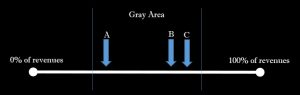
A final note on ethical decision making is that nosotros mostly don't first with the extremes in ethical decision making. We naturally jump correct into the middle of the gray surface area because we know the extremes and the fringes of the gray surface area are not worth pursuing. It is in the gray area that we must navigate, using ethical conclusion making to effigy out the best solution. We can accomplish good decision making using ethical frameworks.
Is the Law Enough?
Before nosotros become to the upstanding frameworks yous can utilize to navigate ethical determination making, we need to address a common question, is the constabulary enough to guide the states in our ethics? The brusque answer is that the constabulary is an insufficient ways to regulate our ethical decision making. At that place are two primary reasons for this. Kickoff, the law gives us bare minimums in terms of safety, human dignity, and respect of rights. However, well-nigh upstanding dilemmas are navigated well higher up these elements. For example, we are required to provide appropriate safety equipment and make sure employees have safety certifications they need. But this does not constitute the entirety of our upstanding obligations in terms of rubber. What is the right decision in keeping a grocery shop open in a pending hurricane? OSHA has no regulation on that. However, nosotros are putting our employees at take chances. H-E-B (grocery chain in Texas) in Houston asked for volunteers and paid employees overtime to keep stores open so area residents. This determination went well beyond the condom minimums the constabulary requires for a grocery store. Another example is that managers are required to respect the terms of a contract. However, the integrity of a company can exist severely challenged if the focus is entirely on compliance. For example, during the 2008 financial crisis, many fertilizer manufacturers held contracts that customers bought at the elevation of the market. The contracts their customers entered into obliged them to pay what would become three times the market place cost later on the crash. However, many manufacturers worked with their customers and renegotiated the contracts to make the customers competitive in the market. This was well beyond the minimum legal requirements of the contracts. Minimum wage indicates the bare minimum your workers need to be compensated, even so, this does not always equate to a living wage

in many metropolitan areas. Each of these examples highlight the need to navigate the upstanding dilemmas we face with something more than the law.
The second reason why the law is non a skillful standard is that sometimes nosotros put in identify some really bad laws. Consider the United States Eugenics movement in the early 1900s. We put in place laws that immune for the forced sterilization of lx,000 Americans that the government adamant were unworthy of reproduction. This included alcoholics, criminals, intellectually disabled, and many more categorizations. Only in hindsight sometimes practice nosotros encounter the errors of the laws we have put on the books.
Ethical Frameworks
Considering the law is insufficient, and the nature of ethical dilemmas is ane of navigating ambiguity, nosotros need to plant frameworks that will assist united states make decisions. The following ethical frameworks are intended to exercise that. Moral relativism offers a local solution to making ethical decisions. Utilitarianism focuses on maximizing the greatest good for the most number of people. Justice view emphasizes the human relationship between members of the organization. Corporate social responsibility encourages consideration for all stakeholders affected by the conclusion making of an arrangement. Past using these frameworks as a guide, nosotros tin can brainstorm to work through a reasonable solution to ethical questions that do not have a glaring, obvious solution. These frameworks give us structure in the gray area. Each has benefits, and faults, but they are at least a starting indicate for establishing upstanding thinking.
Moral Relativism
The construct of moral relativism holds that ethical values and judgements are ultimately dependent upon one's culture, society, or personal feelings (DesJardin, 2011). Under this framework, the right respond to the ethical dilemma will change based on who is analyzing the ethical problem. Moral relativism makes the ethical decision making simple, in that the local perspective should guide the reasoning. If a manager is making a conclusion that is based in Cathay, the Chinese standards of ethics should employ. If a manager is making a decision in South Carolina, as opposed to Alaska, the Due south Carolina worldview would trump the decision making.
There is an important distinction that needs to be made when discussing the idea of moral relativism. That is, there is a significant difference, a giant chasm in fact, between relative truth and objective truth. An instance of a relative truth is something like that of an opinion – who is the greatest between LeBron James, Michael Jordan, and Kobe Bryant. 1 could brand the case for each of these and come to three dissimilar opinions. If I stand up and say that MJ is the best, this is a relative truth. This is my opinion and not true for everyone analyzing the same conclusion. Mint Oreo is the all-time ice cream flavor. Oh, you disagree? Under the construct of relative truths that is ok. Moral relativism works perfectly fine under these weather condition. Examples of this would be in Colombian culture, its ok to show upwardly to social gatherings a tad (I hateful a lot sometimes) bit tardily. Colombians wait this. In Iowan culture, the expectation is that if a meeting or party is scheduled for 3pm, you should show up on time, lest you offend the host. Moral relativism is an adequate practice for cultural norms such as these. However, when it comes to evaluating serious ethical problems, there are some inherent challenges with this framework. This is sometimes called cultural relativism, and when dealing with issues of relative truths, is a mutual business organisation exercise.
In stark dissimilarity to truths that alter, the objective truths never modify. Objective truths can too non contradict each other, otherwise one of them would be false, rendering information technology not objectively true. Here'southward an example: In The Hobbit (i of the best books of all time, my relative truth), Bilbo finds the ring in the cavern where Gollum is hiding. Bilbo engages in a battle of riddles with Gollum, and somewhen wins the intellectual battle by asking Gollum "what's in my pocket?" (Spoiler warning) It's the ring. At this bespeak we tin with certainty decide that there cannot be a ring in Bilbo'south pocket, and simultaneously be null in his pocket. One of those is true. They cannot both be true. The being or absence of a ring is an objective truth. This is a metaphysical example showing that objective truths cannot contradict themselves. In the same style, if I say "there is a God" and an atheist says "no there is not," there is only one thing nosotros can concord on and that is, only one of u.s. can be right.
Let's bring this distinction to the ethical framework of moral relativism. When discussing matters of ethics and the human condition, objectives truths indeed be (every bit illustrated with the God example). In the same fashion we should state "Human dignity should never exist violated" or "man dignity should be compromised in some situations." Both of those cannot be truthful. This means that moral relativism tin can contradict itself. If something is considerately true in i culture, information technology cannot be objectively untrue in another culture. In these situations, moral relativism would be useless as a framework for decision making.
Moral relativism has one final, fatal flaw. The major premise that moral relativism touts is that "no absolute truth exists." Logically, this would be that whatsoever truth that we merits cannot be absolute, meaning it can simply be a relative truth. Still, the premise upon which moral relativism stands is itself an accented truth. Therefore, the statement "there is no absolute truth" cannot be truthful, significant that absolute truth must exist.
This question has been debated for millennia from the Romans, to the Eye Age debaters responding to Thomas Aquina's Summa Theologie, to your high schoolhouse civics teacher preparing the debate squad for a Saturday meet. Exploring it and unpacking it all hither is across the scope of this book. Moral relativism is seriously handicapped from the aforescribed self-defeating premises. However, identifying it and illustrating the fatal inherent flaws is an of import job when studying ethics because iterations and camouflaged versions of this framework are withal used in modernistic business exercise.
A final notation on moral relativism – in addition to the logical fallacy that it presents, at that place is an inherent danger in using this every bit an ethical framework. If all ethical decisions are left up to the local perspective, then fifty-fifty awful practices must be tolerated. This ways that we cannot condemn anything that presents a prima facie case of unethical practice. We would exist unable to condemn child labor, female person genital mutilation, genocide, sex trafficking, Ponzi schemes, and the litany of other wicked practices that are accepted in some cultures.
Utilitarianism
Utilitarian ethics focuses on maximizing the greatest good for the most number of people. Originally consort by the English philosopher, John Steward Manufacturing plant, this ethical framework provides us with a formula upon which to base of operations our decisions. Upstanding decisions should be based on the perceived outcomes they will lead to, and alternatives evaluated based on whether they will maximize the adept from the greatest number of people. Proficient can be divers in several ways. Good tin equate to generation of coin, satisfaction, life, health, opportunity, utility, and anything that is reasonable attributed to improving the human being condition. Past default, this also means that utility maximization also avoids loss of good (loss of life, loss of coin, etc.) Once the choices are evaluated and the estimated outcomes are determined, the upstanding choice is the one that creates the most benefit.
Utilitarianism makes ethical decision making piece of cake once the outcomes accept been projected. Volition this projection potentially harm the local water source? What will that toll in terms of clean up or quality of life? Will building a factory create jobs? Afterwards asking a series of questions like this, the outcomes are estimated to total impact or proficient, however that is defined in your upstanding dilemma. Withal, this ethical framework has ii principal limitations. First, the concept of utility (or skillful) is non always easily divers. Financial analysts can projection income and net present values of decisions, and these decisions are easy to make once the numbers are in. Merely how practice you judge how much satisfaction something volition bring? If a decision is going to result in the loss of life, how much is a human life worth? How do you estimate the impact a decision has on the community's civilisation? Determining utility and then calculating is easy in some cases, but in about it becomes a major claiming to using this framework. The second challenge for utilitarianism is that maximizing the greatest good for virtually, might result in the sacrifice of a few. A archetype instance of utilitarianism is the layoff determination. Nosotros need to lay off xxx people and then that the company stays solvent, and continues to provide jobs for the remaining seventy people. In this example the company stays solvent, but the xxx workers now struggle to provide for their families. Another example is a mass casualty incident. If a trauma ward is overrun with cases, the lead physician must make decisions virtually which patients receive immediate intendance and which ones must be put aside. In this state of affairs, the doctor is trying to salvage the most human life, which might issue in patients with less serious injuries have to await hours in pain to exist treated.

Justice View
The justice view of ethics is 1 that endeavors to care for everyone fairly and impartially. A basic notion of justice is that we should give people what they are due. People are owed respect, dignity, civility, equity, and humanity for case. If we are trying to decide a path forward in an ethical dilemma, nosotros would focus on these principles to make up one's mind which is the correct path forward. If we brand a determination that violates these principles, so justice has been violated, and we should consider alternatives. The justice view equally an ethical framework can be farther dissected into four specific forms – distributive justice, interpersonal justice, procedural justice, and commutative justice.
Distributive justice emphasizes equality when allocating resources. This means that individuals are given a fair opportunity to acquire resources. Resources tin can include salary, opportunities for promotion, benefits, favorable shifts, location preferences, and the similar. To avoid violating distributive justice, managers should non discriminate confronting individuals for the inherent characteristics which would include demographic makeup like race, age, sexual activity, and all of the other categorizations that brand up protected classes in the workplace. However, we must also avert giving preference to the best friend, the family member, the direct report who constantly flatters the managing director, the person who attended the same academy every bit the manager, and any other characteristic outside bodily performance of an private. If, however, an individual has earned privilege through their performance, it is completely justified to provide additional resources. The top performing salesman should receive a bonus. The auditor who continually catches errors should become preferential treatment for time off during taxation season. The logistics scheduler who builds meaningful rapport with dispatchers should be promotion. In each of these cases, the private has earned the right to the resources, and distributive justice has not been violated. If we as managers have some sort of preferred method for doling resources other than what people accept earned through their performance, we are violating distributive justice.
Interpersonal justice an ethical framework that focuses on the advice within a relationship. The essence of this justice view is that the manner in which we communicate determines whether or not justice has been violated. Talking to people with disrespect, belittling, coercing, or being rude or uncivil in a delivery of a message all constitute interpersonal justice violations. Consider the following two scenarios. Scenario #1: Beck has continually underperformed to the bespeak where the manager has adamant that she should be terminated. The director sits down with Brook and calmly explains the consequences of her operation, wishes her well, and on the fashion out the door offers a reference to her for a chore opportunity. Beck is non happy about losing her job, only she does not feel similar interpersonal justice has been violated. Scenario #ii: Otto works as a cost accountant and recently performed above his peers during a mill expansion project. As a issue, the accounting manager has rewarded him with ii tickets to the Milwaukee Brewers game. As the manager hands Otto the tickets he says, "I know that if accountants don't go out of the office, they will whine about it, so here are two tickets." In this scenario, Otto earned the prize so distributive justice was not violated. Still, the manner the manager treated him makes him feel disrespected, a articulate violation of interpersonal justice.
We accept this unstated expectation that we should be treated with dignity. This is why any form of sexual harassment immediately elicits an indignant response. Information technology violates the interpersonal justice view that nosotros should not exist talked to, or treated in a style counter to decency and our humanity. When we are treated with disrespect in the workplace we resent the manager or the system in that moment, and if this happens often enough, inquiry shows that it will touch on our ain functioning, and the operation of the organization (Estes & Wang, 2008). In short, avoid disrespecting people and yous will maintain interpersonal justice.
Procedural justice follows that as long as the protocols and rules are followed, procedural justice has not been violated. If the organization gives out promotions based on how long someone has been at the arrangement, and this is a conspicuously established rule, procedural justice would not exist violated within this context. It might be the case that we disagree with this rule because being at an organization a long time does non make you good at something (like tenure at a university, high school teachers, military promotions), just as long as it is an established dominion, no 1 will feel that procedural justice has been violated. Another example of procedural justice is the style in which people are evaluated for their piece of work. At a customer service telephone call center, companies ofttimes evaluate their employees based on a set of standard metrics. Anybody knows them, there are clocks on the wall to measure them, and at the finish of the evaluation period, everyone knows what to expect. These include metrics like how long calls terminal, did the agent resolve the outcome, and did the client have to call dorsum subsequently to inquire more questions. Again, some of these are measures that could exist improved, and we might disagree with them, but the rules are existence followed and and then procedural justice wins. Consider the example of a professor who has established a rubric for the midterm paper. It has been posted on the Blackboard site, and it was communicated well before the consignment was due. The students work on the paper, submit them, and receive an evaluation that falls exterior the rubric metrics. The professor had not included spelling and grammar equally role of the rubric, simply during the grading of the papers, he hammers the students on this point. The students volition feel that procedural justice has been violated considering the rules (in this case an established rubric) were not followed. Under procedural justice, what the rules are practise not thing. Whether they were followed practice affair.
Finally, commutative justice is a form of justice that is determined based on all parties having full knowledge of the human relationship or transaction. Consider the classic case of going to a motorcar dealer, and upon going to sign the papers, y'all notice a charge for a warranty that you had not agreed to. The salesman put this in the contract without you asking. Immediately you go upset that the salesman tried to pull one over on you. Yous were non given all of the information in the transaction, and therefore commutative justice has been violated. Another scenario where this normally occurs is in free trials for online services. Yous sign upwards for a seven day trial, and at the cease of the trial period, the visitor charges you lot for the full service considering yous did not call to abolish. If an organization has identified some particular dangers, they should warning the employees to the danger so that they can make an informed determination regarding their employment. An example of this is crab fishing in the Bering Sea. Captains make the dangers very clear to people who want to go fisherman and equally a result, commutative justice is not violated. For this same reason, if you determine to become skydiving, you take to sign an acknowledgement of take chances, and waiver of liability before they will let you skydive. The risks include death, broken ankles, middle set on, and paralysis. The skydiving companies are making the risks clear so that they do not violate commutative justice.
The practiced news hither is that the law is on your side. It would be unlawful for someone to include terms inside a contract that the other political party was unaware of. Additionally, the language within the contract has to be written in a way that a reasonable person tin can sympathize it. In the absence of these factors, the court has upheld that some terms inside contracts are non enforceable. These clauses violate commutative justice because we have a right to know what we are agreeing to.
Corporate Social Responsibility
Finally, an ethical framework that has gained in popularity in the last two decades is corporate social responsibility (CSR). CSR is an ethical framework that takes into consideration all of the stakeholders that are impacted by a concern decision. This means that in addition to considering the financial stake that shareholders accept in an organization, the employees, communities, creditors, suppliers, surroundings, and regime should also exist included in the consideration of conclusion making. Klein (2012) states that "every corporation has an overarching social purpose that transcends the operations of corporate social responsibility and, when well understood and effectively integrated, can have profound business and social results" (para 4). The underlying premise with CSR is that business organisation need to do more than simply make money. They need to advance the calendar of the social skillful likewise. Other names for this approach include the triple bottom line and balanced scorecard, whereby companies report on their impact on profit, planet and people (Spreckley, 1981).
Let'southward go back to the outsourcing case. If we consider this conclusion a gray expanse ethical dilemma, we can employ CSR to consider how to move forward. An assay might these questions: What is the profitability of outsourcing our production (shareholders)? How much should nosotros pay in severance to domestic workers (employees)? What is the economical affect on local town where manufacturing plant will close (community)? What economic benefit will the factory in the new land bring to its local customs? Are we violating whatever U.S. laws with our labor practices in the new country (government)? What is the touch on our supply concatenation and vendors (suppliers)? And the listing goes on. CSR as an ethical framework forces companies to think through all stakeholder groups as they make decisions. What should be articulate as a downside to this upstanding framework is that sometimes stakeholders have competing interests. Your decision to move abroad helps the new town, just hurts the old. It has profitability potential, but might require you to utilise a new supplier or creditor, forcing them to detect new business. This is the master criticism with CSR, but the overall idea with this framework is that nosotros need to at least be asking the questions about each group as we brand decisions.
The origins of CSR come up from a classic view of business organisation that profits come offset. In the 1970s, Milton Friedman famously stated that businesses have only one purpose and that was to maximize wealth for the owners. He offered that by taking care of owners, they would by default exist taking intendance of lodge by virtue of providing jobs for employees, who would then be providing economic growth for club, etc. In the 1980s, this idea was challenged by Edward Freeman, who established stakeholder theory – the founding idea for what nosotros phone call CSR today. Since then many businesses have gone beyond just focusing on profits and have established articulate missions on creating social value
CSR has been the focus major corporations and researchers alike over the final two decades. Much of this emphasis has been placed on a related concept of sustainability, which entails the responsible and efficient use of the earth'southward natural resource. Sustainability in recent years has also expanded to enscope social and economic variables as well – treating each of the resources in these domains as resources that require attention, diligence, and consideration.
Critical Thinking Questions
Which chemical element of the decision making process is the about important to get right? Why?
Which ethical framework makes the about sense? Why?
Why is the law not a sufficient standard to use as our ethical guide?
For each of these answers you should provide three elements.
- General Answer. Give a general response to what the question is asking, or make your statement to what the question is asking.
- Exterior Resource. Provide a quotation from a source exterior of this textbook. This tin be an academic article, news story, or popular press. This should exist something that supports your argument. Employ the sandwich technique explained beneath and cite your source in APA in text and then a list of full text citations at the end of the homework consignment of all 3 sources used.
- Personal Story. Provide a personal story that illustrates the point as well. This should be a personal experience you had, and not a hypothetical. Talk about a time from your personal, professional, family, or school life. Utilise the sandwich technique for this every bit well, which is explained below.
Use the sandwich technique:
For the outside resource and the personal story yous should use the sandwich technique. Proficient writing is not only virtually how to include these materials, just about how to brand them flow into what you lot are saying and actually back up your argument. The sandwich technique allows us to do that. It goes like this:

Stride 1: Provide a sentence that sets up your outside resource past answering who, what, when, or where this source is referring to.
Step ii: Provide the quoted material or story.
Stride 3: Tell the reader why this is relevant to the argument you are making.
Chapter References
J., O'Rourke, J., Parboteeah, P., Pierce, J., Reece, Thou., Shah, A., Terjesen, S., Weiss, White, M. (2019). Principles of Management. Rice University, Open Stax: Houston, TX
DeJardin, J. (2011). An introduction to business ethics (4th ed). New York, NY: McGraw Loma.
Estes, B., & Wang, J. (2008). Integrative literature review: Workplace incivility: impacts on
individual and organizational performance. Homo Resource Development Review, 7(two), 218-240
Hannaway, J. (1989). Managers Managing: The Workings of an Authoritative System. New
York: Oxford University Press, P. 39
Klein, P. (2012). Defining the social purpose of business organization. Forbes Online. Retrieved
from https://www.forbes.com/sites/csr/2012/05/fourteen/defining-the-social-purposeof-concern/#14e2188b1cac.
Lussier, R. (2021). Direction Fundamentals: Concepts, Applications, Skill Development. (9th
Ed). Sage Publications: Thousand Oaks, CA.
Nourse, Five. (2016). When eugenics became law: Victoria Nourse reviews a study on a
historic US misuse of biology, the case of Buck V. Bell. Nature, 530(7591)
Spreckley. F. 1981. Social Audit: A Direction Tool for Co-operative Working. Leeds, UK:
Beechwood College.

What Are The Four Different Models Ofethical Decision Making For Human Services,
Source: https://fhsu.pressbooks.pub/management/chapter/ethical-decision-making/
Posted by: kingwern1962.blogspot.com
0 Response to "What Are The Four Different Models Ofethical Decision Making For Human Services"
Post a Comment